How a water ionizer electrolysis chamber actually works
This version fixes the scientific issues from the earlier animation. It clearly separates ion migration in the water from electron flow in the external circuit, shows the correct half-reactions at each electrode, and gives the animation much more space so visitors can actually understand what is happening.
Electrons are shown only in the wire / external circuit, not floating through the water.
H⁺ is generated at the anode, while OH⁻ and H₂ are generated at the cathode.
Cations move toward the cathode; anions move toward the anode.
It reduces mixing and allows ionic conduction / charge balance across the cell.
The animation is now larger, more layered, and step-by-step.
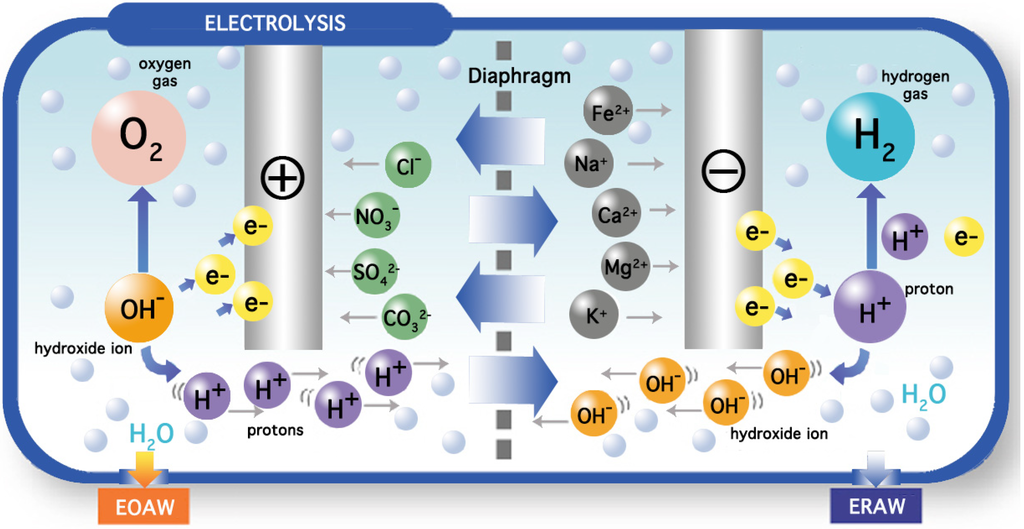
Original paper figure
Reference visual from the paper.
Large animated teaching model
Use the step buttons to walk visitors through the process. The animation is simplified, but the chemistry is now represented correctly.
Tap water enters with dissolved minerals. These ions make the water conductive enough for electrolysis to occur.
In the water, cations migrate toward the cathode and anions migrate toward the anode. This is how the solution carries charge. Electrons are not moving through the bulk water.
At the anode, water is oxidized: 2H₂O → O₂ + 4H⁺ + 4e⁻.
Oxygen forms and protons accumulate, so this side becomes more acidic and oxidizing.
At the cathode, water is reduced: 2H₂O + 2e⁻ → H₂ + 2OH⁻.
Hydrogen forms and hydroxide accumulates, so this side becomes more alkaline and reducing.
The diaphragm limits bulk remixing while allowing ionic conduction / charge balance. The anode side yields EOAW (acidic oxidized water), and the cathode side yields ERAW (electrolyzed reduced alkaline water containing dissolved hydrogen and increased OH⁻).
Correct half-reactions
These are the core reactions that matter for the simplified educational model.
This is oxidation. Oxygen gas is generated at the anode and protons accumulate, lowering pH. In alkaline notation, the same chemistry is often written as 4OH⁻ → O₂ + 2H₂O + 4e⁻. Both expressions describe the same overall oxygen-evolution process from different pH perspectives.
This is reduction. Hydrogen gas forms at the cathode and hydroxide ions accumulate, raising pH. Some of the H₂ escapes as bubbles and some may remain dissolved in the reduced alkaline water stream.
What viewers should understand
The key scientific ideas behind the diagram.
| Element | Scientifically correct interpretation |
|---|---|
| Electrons | Travel in the external circuit and at electrode surfaces; they are not free particles moving through the water bulk. |
| Ions in water | The electrolyte current is carried by ions: cations move toward the cathode, anions toward the anode. |
| Diaphragm | Reduces bulk mixing and supports ionic conduction / electroneutrality between compartments. |
| EOAW side | More acidic and more oxidizing due to oxygen evolution and proton generation at the anode. |
| ERAW side | More alkaline and more reducing due to hydrogen evolution and hydroxide generation at the cathode. |
| Dissolved hydrogen | Some hydrogen remains dissolved in the cathode-side water and is one of the main chemically relevant features discussed in the paper. |
How a water ionizer electrolysis chamber actually works
```This version clearly separates ion migration in the water from electron flow in the external circuit, shows the correct half-reactions at each electrode, and gives the animation enough space so visitors can understand what is happening.
Electrons are shown only in the wire / external circuit, not floating through the water.
H⁺ is generated at the anode, while OH⁻ and H₂ are generated at the cathode.
Cations move toward the cathode; anions move toward the anode.
It reduces mixing and allows ionic conduction / charge balance across the cell.
The animation is larger, more layered, and step-by-step.
Original paper figure
Reference visual from the Henry & Chambron paper.
Large animated teaching model
Use the step buttons to walk visitors through the process. The animation is simplified, but the electrochemical logic is represented correctly.
Tap water enters with dissolved minerals. These ions make the water conductive enough for electrolysis to occur.
In the water, cations migrate toward the cathode and anions migrate toward the anode. This is how the solution carries charge. Electrons are not moving through the bulk water.
At the anode, water is oxidized: 2H₂O → O₂ + 4H⁺ + 4e⁻.
Oxygen forms and protons accumulate, so this side becomes more acidic and oxidizing.
At the cathode, water is reduced: 2H₂O + 2e⁻ → H₂ + 2OH⁻.
Hydrogen forms and hydroxide accumulates, so this side becomes more alkaline and reducing.
The diaphragm limits bulk remixing while allowing ionic conduction / charge balance. The anode side yields EOAW, and the cathode side yields ERAW, which contains dissolved hydrogen and increased OH⁻.
Correct half-reactions
These are the core reactions that matter for the simplified educational model.
This is oxidation. Oxygen gas is generated at the anode and protons accumulate, lowering pH. In alkaline notation, the same oxygen-evolution process is often written as 4OH⁻ → O₂ + 2H₂O + 4e⁻.
This is reduction. Hydrogen gas forms at the cathode and hydroxide ions accumulate, raising pH. Some H₂ escapes as bubbles and some may remain dissolved in the reduced alkaline water stream.
What viewers should understand
The key scientific ideas behind the diagram.
| Element | Scientifically correct interpretation |
|---|---|
| Electrons | Travel in the external circuit and at electrode surfaces; they are not free particles moving through the water bulk. |
| Ions in water | The electrolyte current is carried by ions: cations move toward the cathode, anions toward the anode. |
| Diaphragm | Reduces bulk mixing and supports ionic conduction / electroneutrality between compartments. |
| EOAW side | More acidic and more oxidizing due to oxygen evolution and proton generation at the anode. |
| ERAW side | More alkaline and more reducing due to hydrogen evolution and hydroxide generation at the cathode. |
| Dissolved hydrogen | Some hydrogen remains dissolved in the cathode-side water and is one of the main chemically relevant features discussed in the paper. |